OpsRamp provides a scalable and AI-driven IT operations management platform designed to meet the dynamic needs of enterprises operating in hybrid, multi-cloud, and on-premises environments. The choice of deployment model is crucial in determining how organizations integrate OpsRamp within their existing IT landscape.

Cloud-Native (SaaS) Deployment
Organizations opting for this model benefit from rapid onboarding, multi-tenancy, and the ability to monitor diverse IT resources across cloud and on-premises environments without worrying about infrastructure management. This approach ensures that IT operations teams have immediate access to OpsRamp’s full feature set.
Hybrid Deployment
Enterprises that require a balance between cloud capabilities and local infrastructure control opt for OpsRamp’s hybrid deployment model. In this configuration, an OpsRamp Gateway is deployed on-premises to collect, aggregate, and securely transmit telemetry data from various IT assets to the OpsRamp Cloud. This approach enables organizations to leverage the computational power of the OpsRamp Cloud while maintaining operational resilience within their own network.
On-Premises Deployment
Organizations with strict regulatory needs can opt for a fully on-premises OpsRamp deployment, where all components, including the Gateway, analytics engine, and automation workflows, run within a private data center. This ensures complete control over IT monitoring, alerting, and remediation, meeting high security and compliance standards. Financial institutions, government agencies, and healthcare providers often prefer this model for strict data governance.
OpsRamp Deployment Process
The OpsRamp platform consists of multiple layers working together to enable full-stack observability and automated IT operations. These components are structured to work seamlessly and interact with one another to provide IT operations teams with a centralized, real-time view of their infrastructure. Below is a detailed breakdown of the different components of OpsRamp and how they are structured and connected:
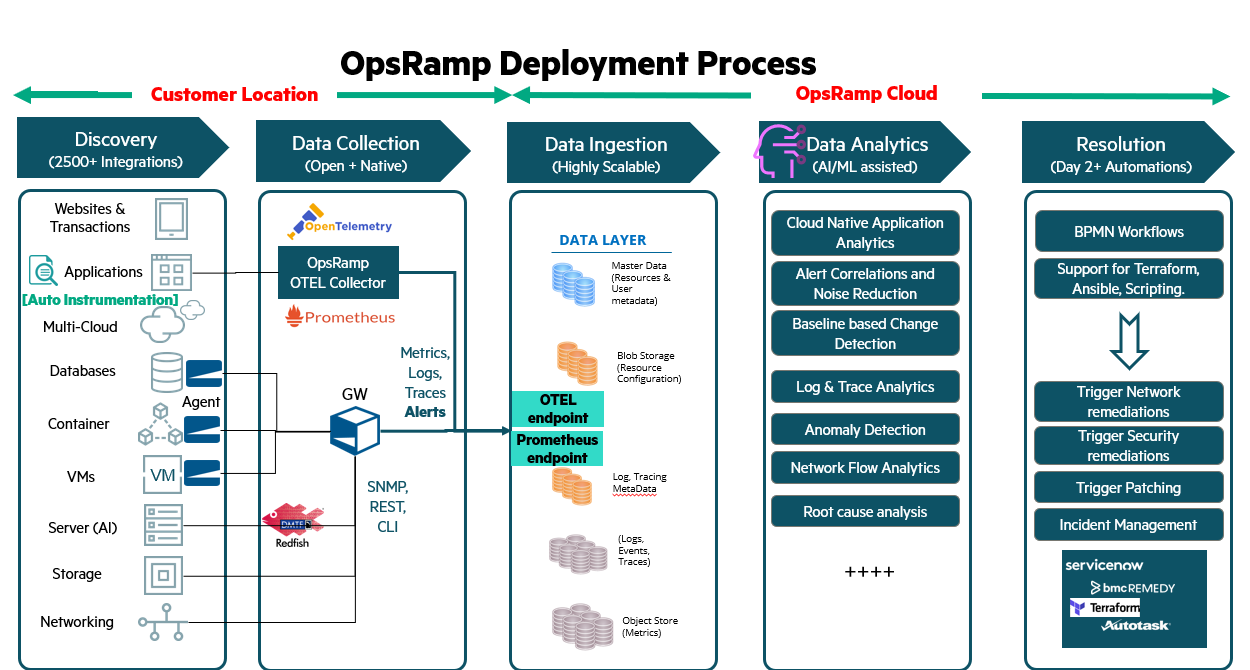
- Discovery and Monitoring Layer
This layer identifies and tracks IT resources across hybrid cloud and on-premises environments. Discovered assets are added to the OpsRamp inventory, ensuring all resources are accounted for. Monitoring policies are applied based on asset type, enabling automated tracking of availability, performance, and resource consumption.
Key Components
OpsRamp Gateway (Agentless Monitoring) – Discovers cloud instances, network devices, and storage systems without requiring local agents.
OpsRamp Agents (Agent-Based Monitoring) – Installed on virtual machines and containers for deep monitoring.
APIs and Protocols – Uses SNMP, REST, OpenTelemetry, and Prometheus for integration with third-party tools.
- Data Collection and Ingestion Layer Once resources are discovered, OpsRamp starts collecting telemetry data—including performance metrics, logs, and traces—from IT assets. This data is then ingested into the cloud for further analysis. The OpsRamp Gateway aggregates and transmits data to OpsRamp’s cloud analytics platform. Data pipelines ensure secure and efficient transport, preventing data loss or corruption.
Key Components
OpsRamp Gateway & Agents – Collect infrastructure and application-level data.
Third-Party Data Sources – Supports Prometheus, OpenTelemetry, and CloudWatch integrations.
Data Pipelines – Securely transmits collected data to the OpsRamp Cloud.
- AI-Driven Data Analytics Engine OpsRamp’s analytics layer processes vast amounts of telemetry data using AI-driven insights, event correlation, and automated anomaly detection.AI models process historical and real-time data to detect patterns, anomalies, and potential failures. OpsRamp’s Root Cause Analysis Engine identifies dependencies between alerts, reducing MTTR (Mean Time to Resolution).
Key Components
Machine Learning Models – Identifies performance bottlenecks and predicts outages.
Event Correlation Engine – Groups related alerts to minimize noise.
Incident Analysis Dashboard – Provides deep insights into system health and performance.
- Automation and Remediation Layer The final step in the OpsRamp deployment model involves taking proactive or automated remediation actions to resolve IT incidents. When an issue is detected, OpsRamp triggers an automated response based on pre-configured workflows. If automation cannot resolve the issue, OpsRamp creates an ITSM ticket, ensuring IT teams take immediate action.
Key Components
Automation Workflows – Executes scripts and predefined actions to resolve incidents.
ITSM Integrations (ServiceNow, BMC Remedy) – Automatically escalates unresolved issues.
Infrastructure-as-Code (Terraform, Ansible) – Applies automated configuration changes and patches.